New Mexico releases body cam video of Harjinder Singh traffic stop to show ‘no communication issues’ with trooper
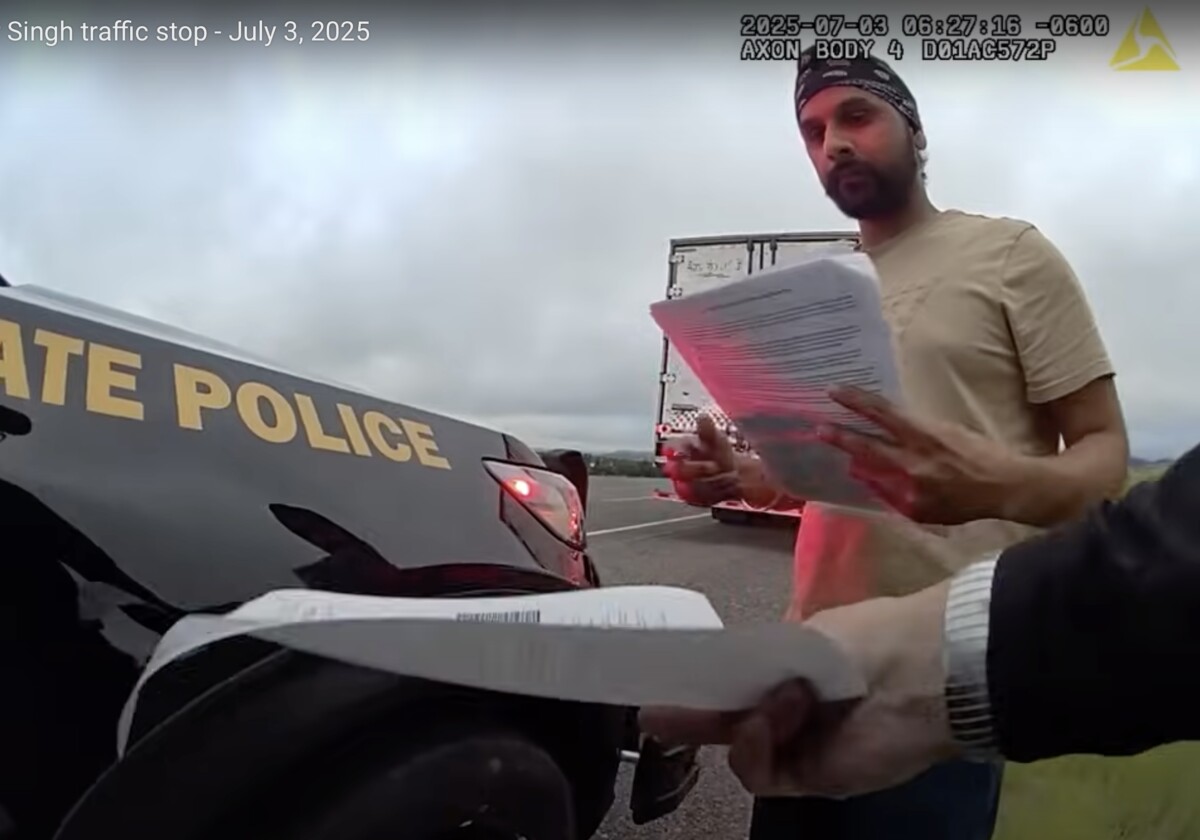
New Mexico State Police (NMSP) released body cam footage from a traffic stop on truck driver Harjinder Singh after federal officials accused the state of improperly enforcing English Language Proficiency (ELP) regulations for commercial vehicle drivers.
On August 26, the U.S. Department of Transportation (USDOT) accused New Mexico, along with California and Washington State, of failure to properly enforce ELP and Commercial Driver’s License (CDL) standards in the wake of Singh’s triple fatality crash on the Florida Turnpike on August 12. USDOT threatened to cut federal funding to these three states if they fail to properly enforce ELP rules within 30 days.
In response, NMSP released body cam video from a July 3, 2025, traffic stop on Singh for speeding at 55 m.p.h. in a 45 m.p.h. zone. The twenty-nine minute long video shows the verbal interactions between Singh and a NMSP trooper as part of the traffic stop as well as the trooper performing a Level II inspection on Singh’s semi truck.
Troopers say that the video demonstrates that “there were no communication issues between Mr. Singh and the officer. Therefore, there would have been no reason to initiate an ELP assessment.”
From NMSP:
“Regarding the July 3, 2025, traffic stop of Mr. Singh: even if ELP testing had already been in effect, no assessment would have been conducted in this case. Both the Federal guidelines and today’s statements by the U.S. Department of Transportation make clear that ELP assessments are only required when there is a challenge in communication. As the video of the traffic stop demonstrates, there were no communication issues between Mr. Singh and the officer. Therefore, there would have been no reason to initiate an ELP assessment.
Additionally, it is important to note that there is no easily accessible way for us to know if a driver has been placed out of service for a previous violation. No automatic alert exists, and such information could only be obtained by manually reviewing numerous documents, something that is neither feasible nor realistic for an officer to do on the side of the road during a traffic stop. To learn more about a driver or their company, an officer must access a specific database and review inspection records from across the nation.
The “flashing red light” Secretary Duffy mentioned merely reflects a company’s overall safety score and is not tied to an individual driver’s record.“
Troopers also pointed to a lack of clarity from the federal government on how to enforce ELP rules when they went into effect on June 25, 2025:
“On June 25, 2025, new federal guidelines regarding the ELP testing for commercial motor vehicle drivers went into effect. While general guidelines were issued, no standardized testing procedure was provided. When State Police sought clarification, the response received was simply, “You know when somebody doesn’t speak English.”
Prior to June 25, 2025, NMSP asked several times if additional standardized guidance would be forthcoming and were told there would not be. As a result, New Mexico developed its own process to comply with the new requirements.“
“This process required careful review and statewide training for our personnel to ensure consistent and fair application” NMSP Chief Troy Weisler said. “It was critical that we implement this correctly, both to comply with federal law and to reduce the risk of litigation, as has occurred in other states such as Florida.
“Contrary to statements made at the US Department of Transportation’s press conference this morning by Secretary Duffy, we kept the Federal Motor Carrier Safety Administration (FMCSA) field division in New Mexico informed of our progress with updates on July 24 and again on August 12, 2025,” Weisler said. “This was all prior to our agency becoming aware of the tragic crash that occurred in Florida.”
NMSP stated that “New Mexico had a set timeline for implementation and continues to plan to meet that timeline by initiating enforcement of ELP requirements on September 1, 2025.”
“The tragic loss of life recently suffered by the people of Florida serves as a painful reminder of why these regulations matter,” Weisler said. “We extend our deepest condolences to the families and communities affected by this tragedy. Ensuring the safety of all who travel on our nation’s roadways remains our highest priority, and we are committed to applying these requirements with the seriousness and consistency they demand.”